Publisher: Konami
Developer: Konami
Release Date: August 27, 2024 (original release November 16th, 2006)
Version Played: Nintendo Switch
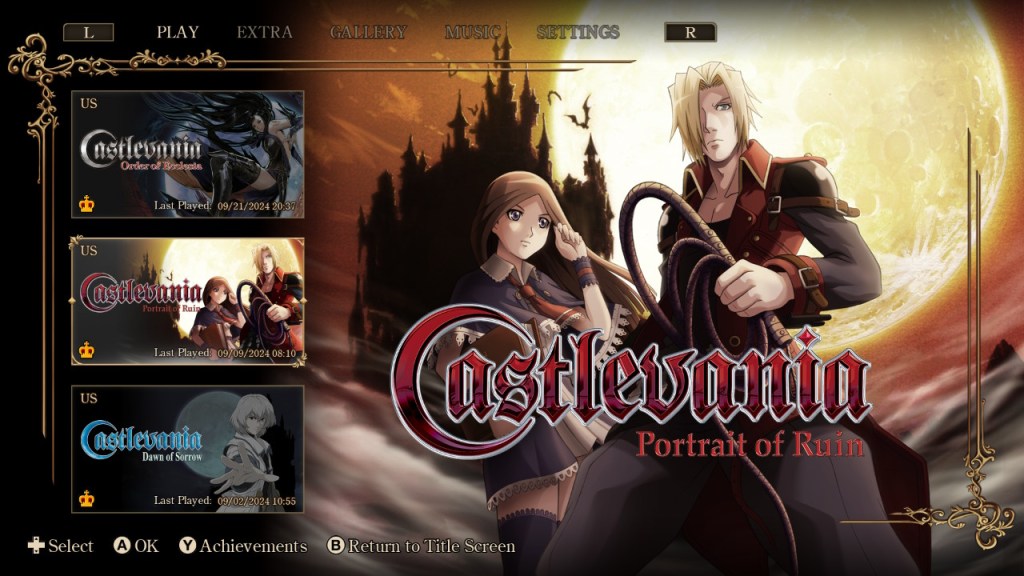
This article is the third of a four-part series on Castlevania Dominus Collection.
Click here to jump to Part I – Castlevania Dominus Collection.
Click here to jump to Part II – Castlevania: Dawn of Sorrow.
Click here to jump to Part IV – Castlevania: Order of Ecclesia.
This article contains full spoilers for Castlevania: Portrait of Ruin.
I still remember the slightly painful experience I had when Portrait of Ruin first released. My mum had driven me to the nearby town of Saint-Jovite so I could buy it from the nearby combination Superclub Vidéotron/Microplay (make sure to say that in the heaviest Québec accent you can manage), which was my go-to store at the time, thanks to its proximity to three huge grocery stores my parents frequented. As a young Castlevania diehard, I was pumped out of my mind for the latest entry, but in my excitement, I’d forgotten to charge my Nintendo DS. After collecting the game, my mum parked the car at a nearby shop where she needed to order or buy some household appliance thing, and I stayed in the car. Within five minutes, the power indicator began flashing red, reminding me to hit a save point else start the game over again. I begrudgingly acquiesced and put my DS aside. Given we didn’t really have cellphones at the time, the game’s manual kept me company for the next hour and a half or so until I could start it up at home, and boy those twenty or so pages flew. This was a huge exercise in patience for me, and I most certainly did not like it.
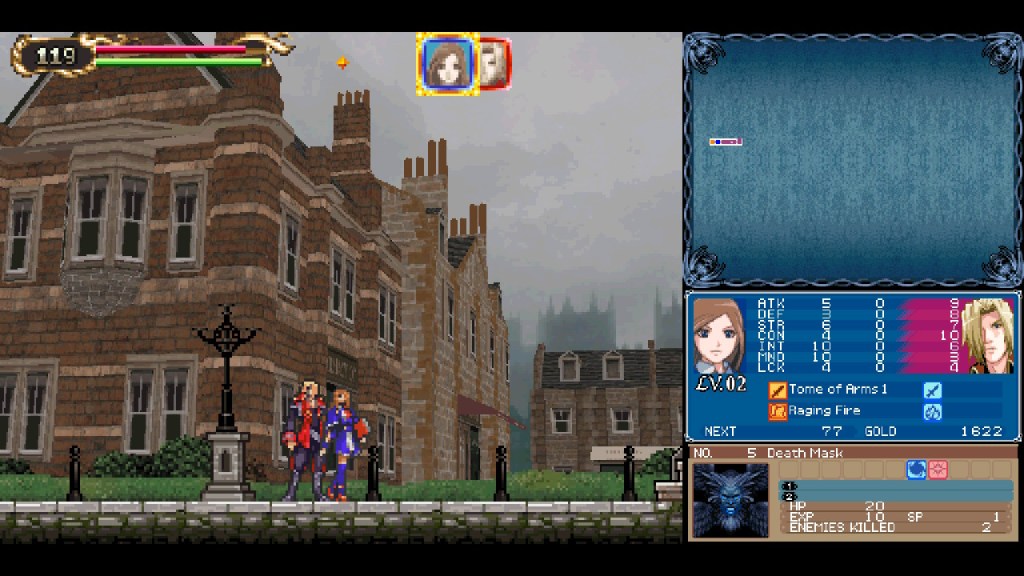
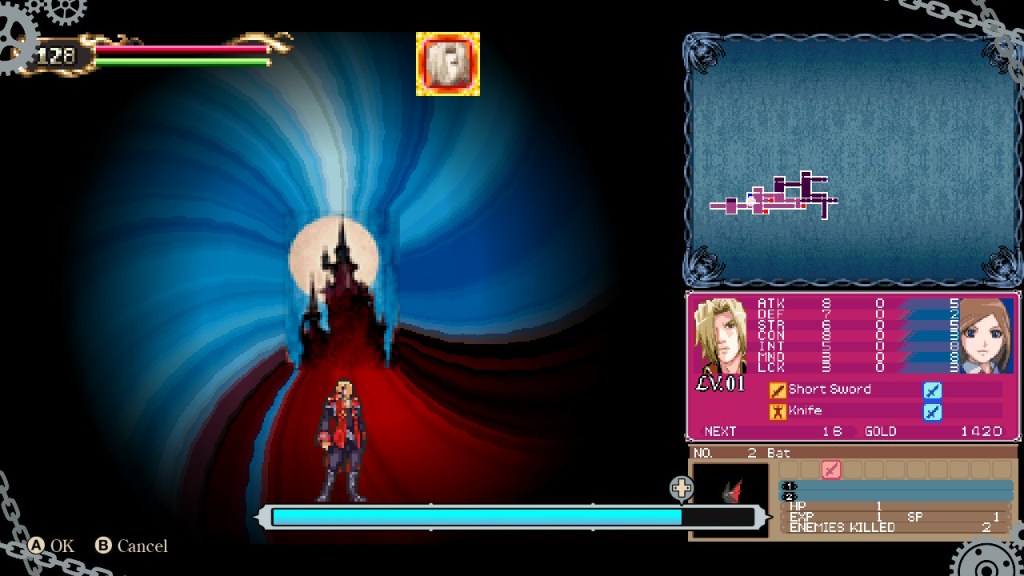

I do, however, remember liking the game itself quite a lot. Though the finer details escaped me when I booted it up again on Switch, I knew at least that I’d finished it many times as a kid, and some of the unforgettable broad strokes never left me. The tag-team protagonists Charlotte and Jonathan, of course, the extremely cool unlockable Old Axe Armor mode, and something about a pair of vampire baddies in the villain cast. I must say, I’d forgotten a great deal about this game despite this one being the one I probably played the most of the three DS titles, but it’s all come back to me now, and I’m glad. Portrait has comfortably landed at the top of my DS Castlevania tier list in the end.
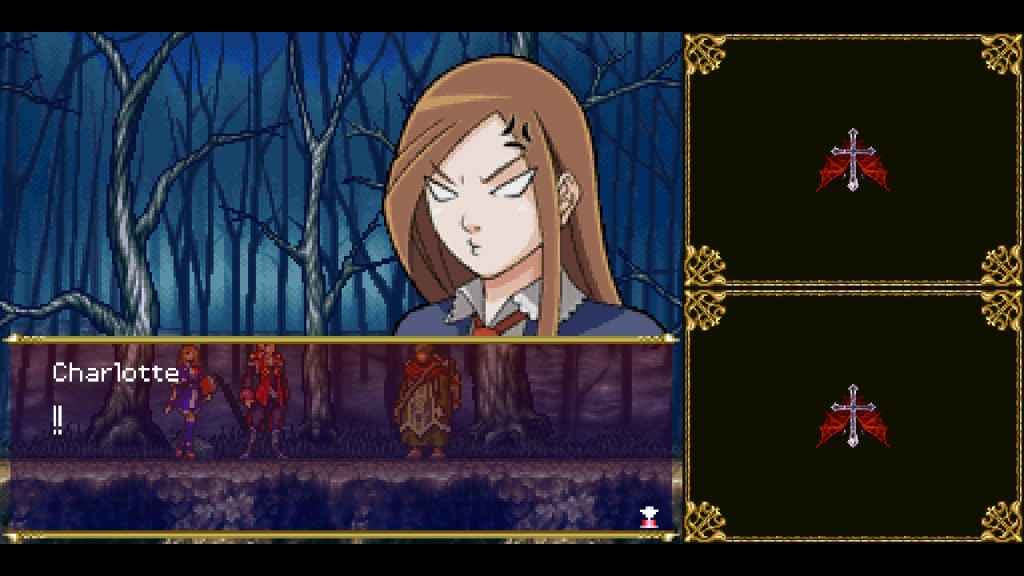
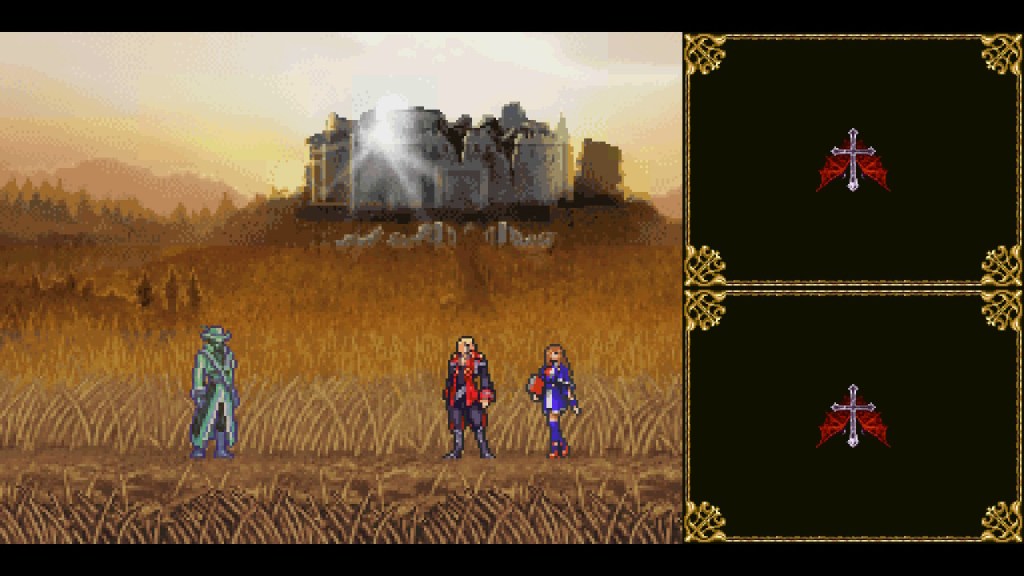
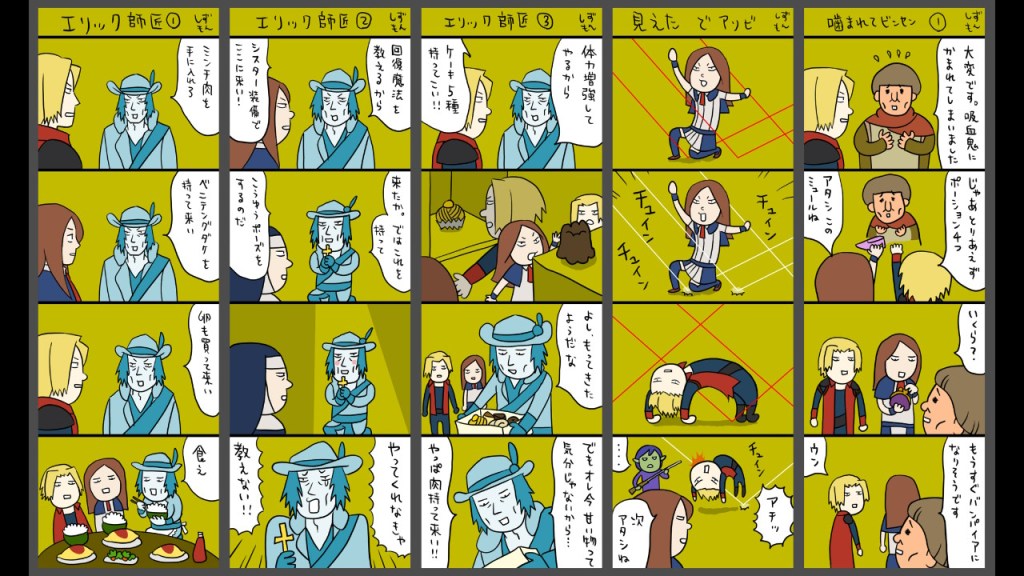
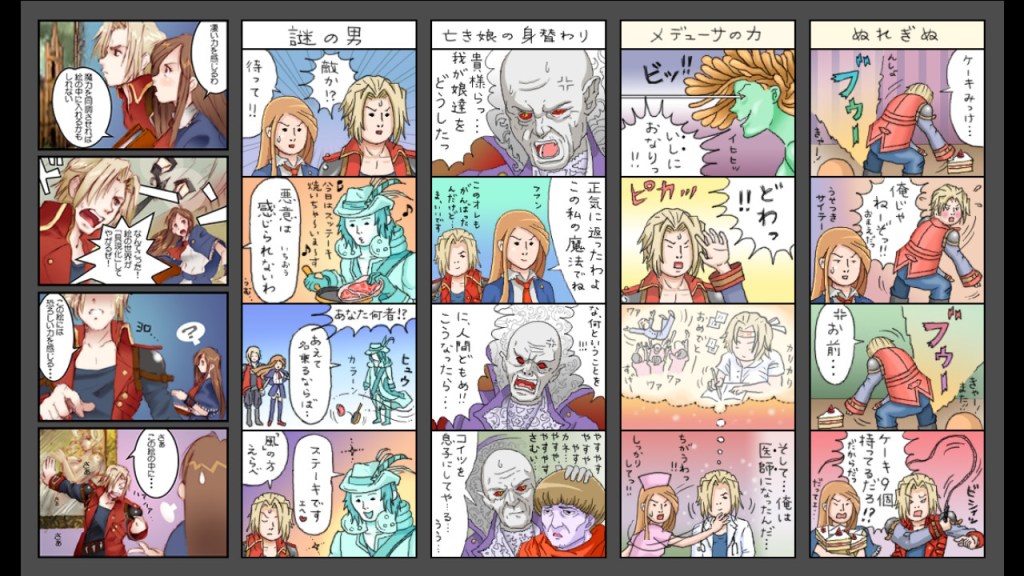
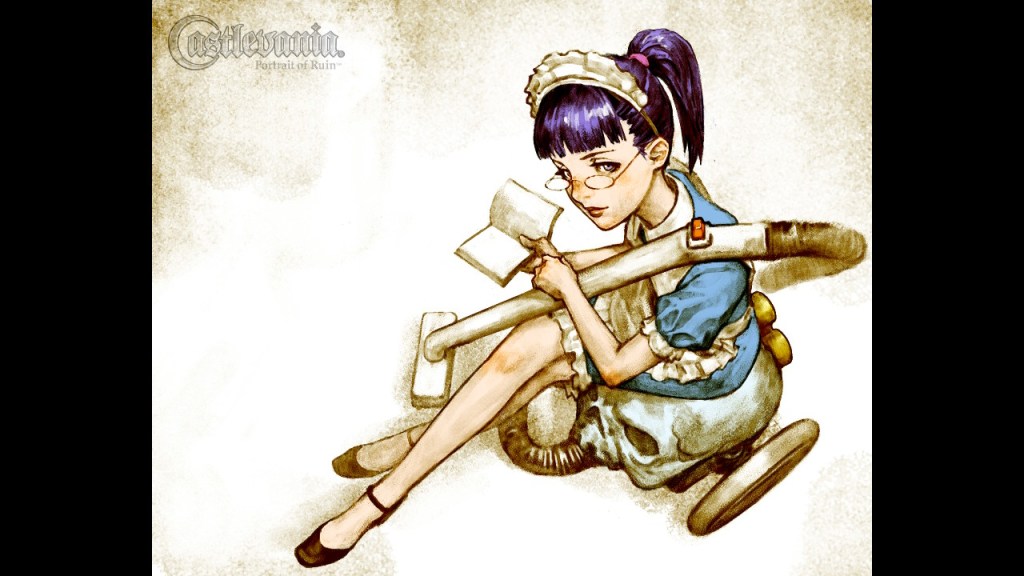
In what I assume to be a continued bid to combat declining series sales in Japan, Portrait of Ruin’s art direction follows Dawn of Sorrow’s choices with fairly generic anime art headlining the show. Though the cast have largely solid designs, the look of the whole thing is brought down somewhat by bland art direction, with character designs that feel almost as though they were simplified down for TV anime from some more intricate nonexistent original manga. That being said, where Dawn felt like it represented a significant downgrade from Aria in this regard, Portrait having an all new cast helps a lot. Soma looked a whole lot cooler in Aria than Dawn, but Jonathan having no previous iteration means plain anime art Jonathan still gets to be the coolest version of himself. Additionally, the team utilized the style more by including some 2000’s era anime reaction faces that really work in this game, even if they feel somewhat out of place in the larger canon of Castlevania. While the main story is still serious- wound surprisingly tightly around the narrative of 1994’s Castlevania: Bloodlines- the dialogue and character writing make Portrait the most intentionally humorous and otherwise silly “mainline” Castlevania game. It’s an interesting choice, but it does legitimately help differentiate it without spoiling the occasion.

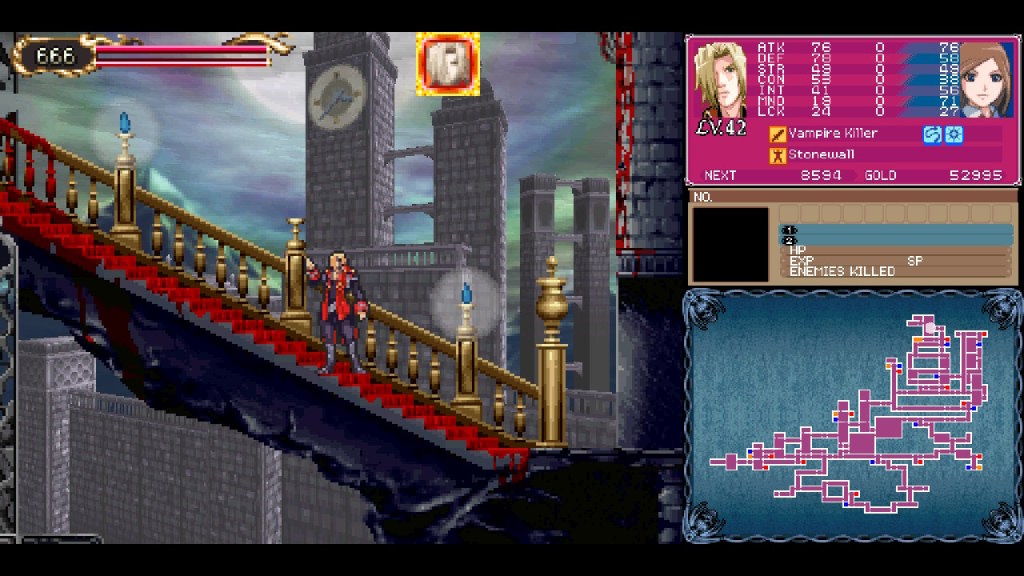
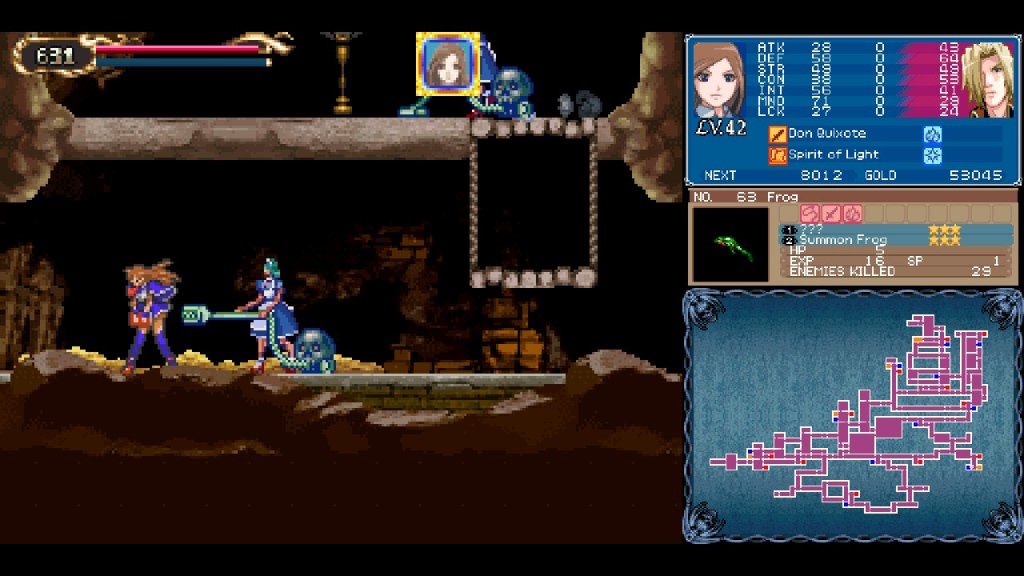
Character portraits aside, the art during gameplay sequences is thankfully just as sumptuous as Dawn’s amazing stuff, but with even more sneaky 3D in play this time such as the Egypt stage’s pyramid and sphinx, which are subtly rotated as you advance through the stage. New enemies complement legacy sprites that at this point have been carried forth multiple hardware generations, and creative elements like Charlotte’s attacks (where she equips a variety of books whose contents burst out as you swing them) add a lot to the overall presentation. Early on, you’ll find an equippable Don Quixote book for her, and when he and his windmill adversary burst out for the first time, it makes a lasting visual impact. Really cool stuff.
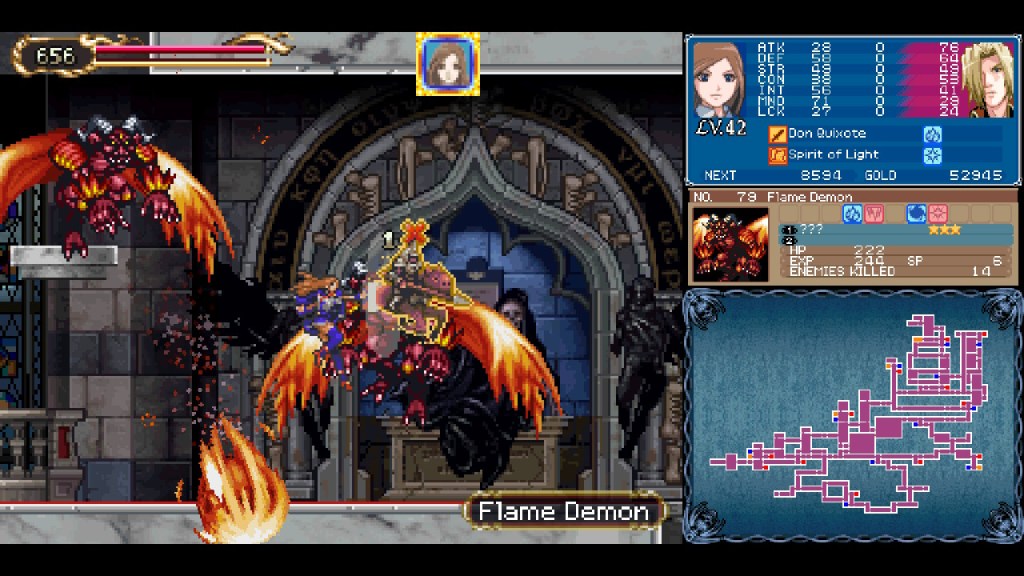
Moving on to gameplay, there’s a lot I want to compliment here. The dual character setup is totally excellent, allowing you to swap between Jonathan and Charlotte with the press of a button. I had forgotten that you can also summon your partner to fight alongside you as well, which really makes you feel quite powerful as the AI is definitely decent enough to get hits in. Should they take hits, however, you’ll take the damage to your MP. MP damage can be extremely dangerous since it’s needed for most of your abilities and the new Dual Crash system (which we’ll loop back around to in a second), so thoughtful use of partner summoning feels very necessary! It’s an elegant little risk/reward element.
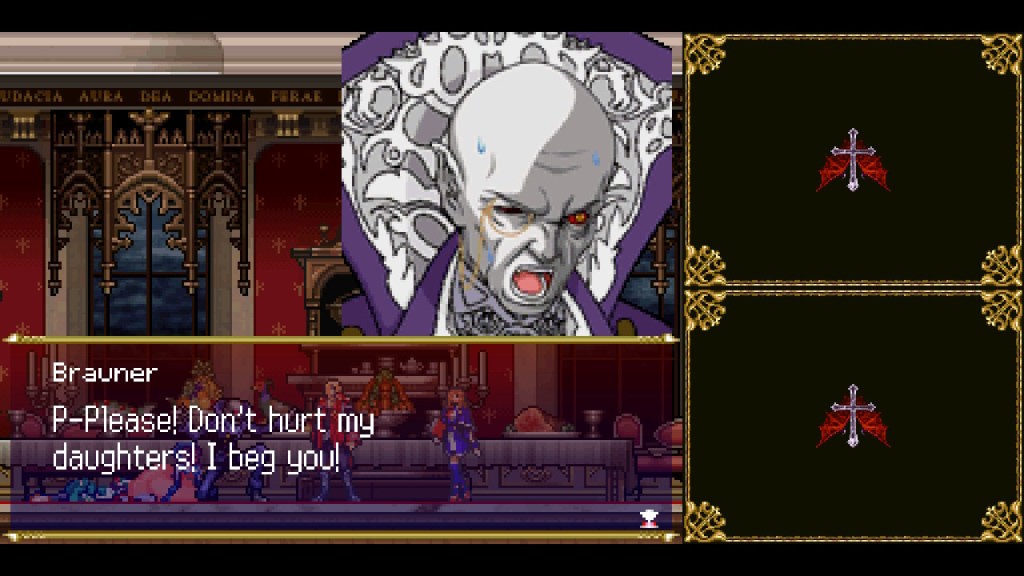
The setting for the journey is largely Dracula’s Castle, which serves as the main hub and a sizable map itself. Similar to Super Mario 64, the castle is filled with portraits which will whisk you away to separate maps in faraway lands like London and Egypt, allowing for a really wide breadth of environmental art which they capitalize on well. If I’m remembering correctly, this is the first Igarashi directed Castlevania that breaks things up into such clearly sectioned off “levels” in this way, and I think it really works well in this game! They never feel quite as open as previous games in the series, but they’re not yet as uncompromisingly linear as Order of Ecclesia. One really nice narrative design element is that the game’s initial antagonist, Brauner, has painted the portraits himself! This artistic side of his recurs when you eventually face him in combat, and it adds a nice little aesthetic wrinkle to him when many Castlevania antagonists are very one note. Brauner triples up as a vampire, a painter, and a single father, and that’s a lot more than you can say for Dracula!
On the character skills side of things, the two characters have really different designs, which makes for an awesome duality of play. Jonathan’s skills are largely sub-weapons like the more traditional Castlevania characters wielded (knives, axes, etc), and there are dozens in total. Through repeated use, these skills will level up and become significantly stronger, which is cool, but I think that the leveling is far, far too slow. Depending on your character preferences it’s very possible to see the credits with very few weapons leveled, if any at all. Nonetheless, a cool idea. He also comes equipped with commands you can perform in a manner similar to special attacks from fighting games (though this is actually also returning from past Castlevania games), which give him access to an array of no-cost mobility and offensive options you’ll unlock as you play.
Charlotte differs greatly from Jonathan. She loses out on the command abilities completely, but comes with the ability to cast a slew of powerful spells which have both an instant cast effect and a stronger charged effect. Although her spells don’t level up like Jonathan’s subweapons,, they don’t feel like they need it as the effects are usually quite a bit more substantial right out of the box.
Finally, the most powerful abilities are called Dual Crashes- extremely powerful, potentially screen-clearing skills you can use by spending a ton of your MP meter. In most cases you’ll become invincible during their use as well, so they’re versatile whether you’re just trying to absolutely pile on damage, or escape a dire situation. I sadly do have one complaint about Dual Crashes, which is more of a UI thing than a Dual Crash thing itself, but your MP bar flashes continuously as long as you have enough built up to trigger your currently equipped Dual Crash. It’s not the end of the world, but I would have turned this off or opted for something less distracting if I could have since it has such a visually loud appearance.
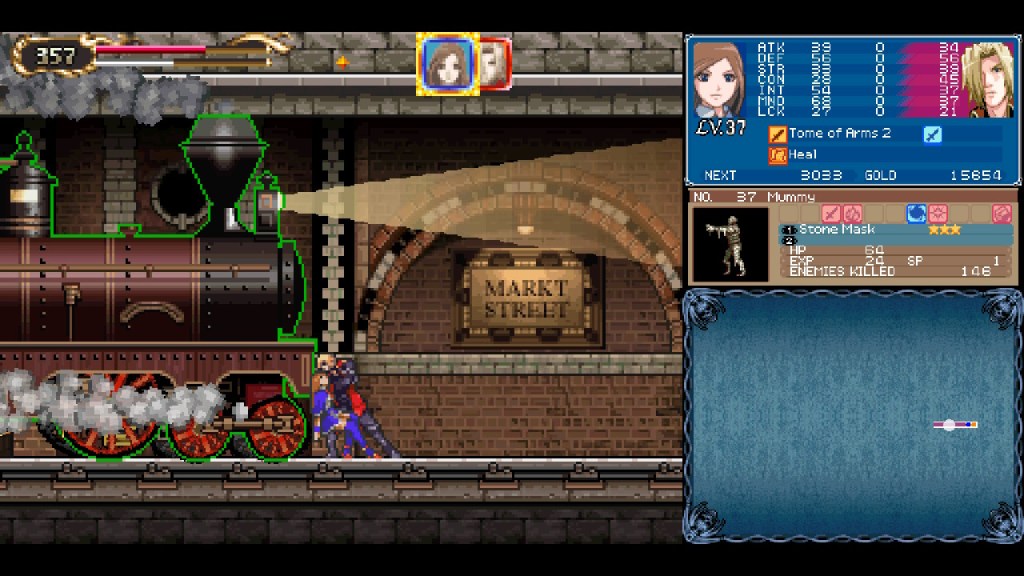
The game also introduces various teamwork abilities for use largely during platforming sections. The main set are the Push Cube (which allows cooperative pushing of obstacles), the Wait Cube/Call Cube (allowing you to tell your partner to wait or come to you), and the Acrobat Cube (which lets you perform an extra midair jump off of your partner’s shoulders) are all tools we’ve seen before in one way or another, but the way they work with your partner and the level design is something we’ve truly not seen before or since in Castlevania titles. The Acrobat Cube is of particular note here, because the jump off of your partner’s shoulders can stack with your double jump, allowing for even more airborne mobility via what is a de facto a more limited third mid-air jump. There was a moment early on where I found myself very impressed with the Acrobat Cube, as most of these Igarashi Castlevanias give you the double jump ability quite early and call it a day on platforming challenges. Acrobat Cube changes the game a bit, as the extra height grants you more ability to explore the castle without immediately granting you the ridiculously powerful double jump, and it also requires thoughtful ally placement to use it in a frantic moment. I had completely forgotten this, and I was deeply impressed with the design choice to introduce this half-step to character air mobility when double jump is such a standard.
Sadly, I then realized that the double jump is literally the very next character upgrade you get, so my impressed feelings were pretty much spoiled within a half hour. Oh well. Still cool.
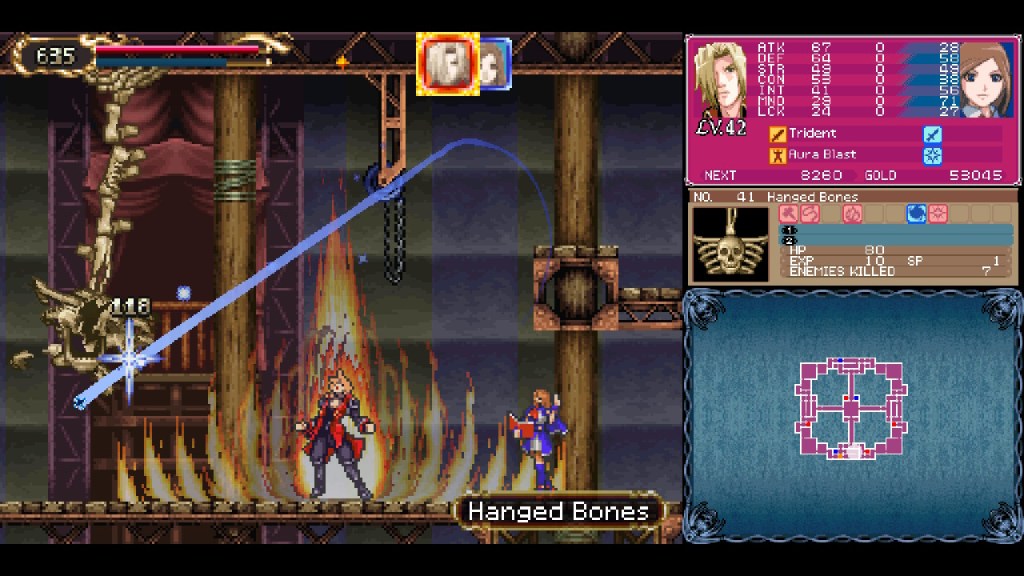
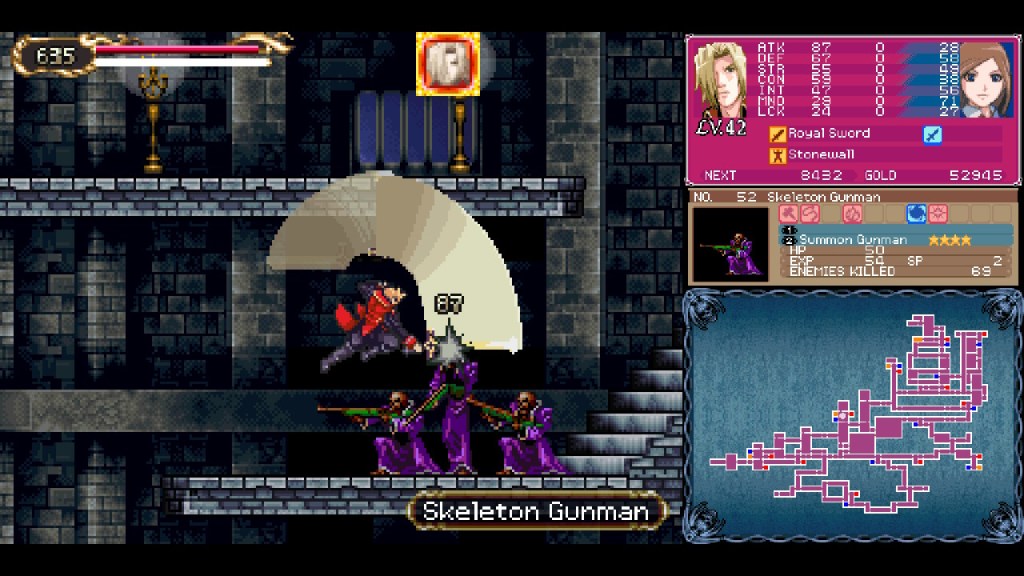
I’ve mostly skipped over the story and narrative design up to this point, but I’d be remiss to not go over it because it does some rad stuff. While Charlotte is a perfectly capable witch and proud of it, Jonathan is… struggling. Bearing the Morris family name, he’s a descendant of the Belmont clan (you’re just going to have to trust me on this or look up a family tree), and thus he should be able to wield the legendary Vampire Killer whip. The legendary whip was left to Jonathan as his birthright but he bears a deep resentment towards his father for never teaching him how to tap into its power. Why wasn’t he taught this? Did his father deem him unworthy? Whatever the answer, Jonathan is tortured by his existence and inability to tap into the power that people assume he should have. From the very beginning of the game, you have the Vampire Killer in your inventory, but without the ability to utilize its power, it will languish there as one of the worst weapons in the game, and a symbol of Jonathan’s lifelong struggle. As the game goes on, Jonathan will learn various abilities that harken back to previous vampire slayers from a mysterious spirit that has taken residence in the castle, as he gradually finds his place in the world and learns more about his father.
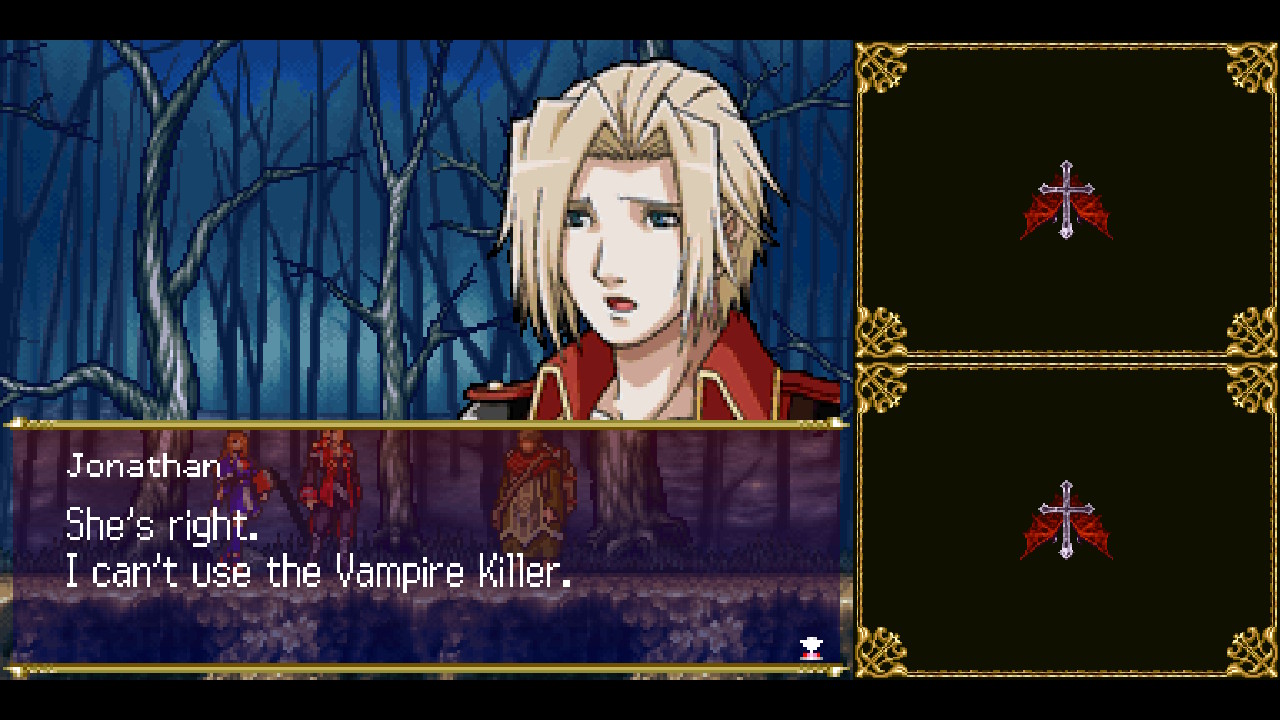
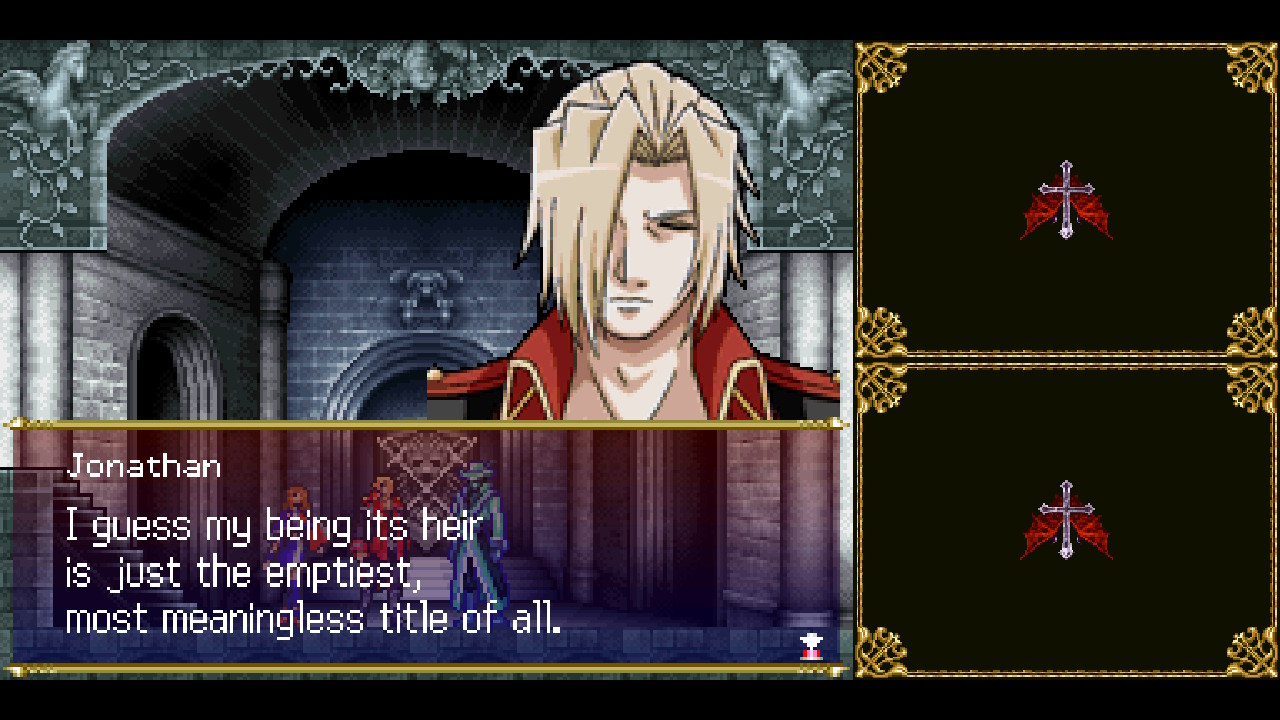
Eventually, a key character is able to help him unlock the whip’s power, which allows you to face a completely optional boss in a solo duel any time thereafter. Spoilers ahead! The boss- Whip’s Memory- takes the form of Richter Belmont, the last full Belmont to wield the Vampire Killer. By all odds, the Whip’s Memory will kick your ass when you first encounter it. You can overcome it with dexterity, but most people will probably want to train Jonathan up more before attempting to fight it for real. Whether you manage to overcome the Whip’s Memory through the intended dramatic battle or the absolutely ridiculous Cream Pie sub-weapon (which inflicts heavy Dark element damage, exploiting Richter’s Holy element affinity), you’ll obtain the fully-powered Vampire Killer. Though its raw attack power doesn’t quite compete with the best weapons in the game, its holy damage type gives it a huge unique edge against the remaining main bosses in the game that you don’t get from the rest of the top-tier weapons.
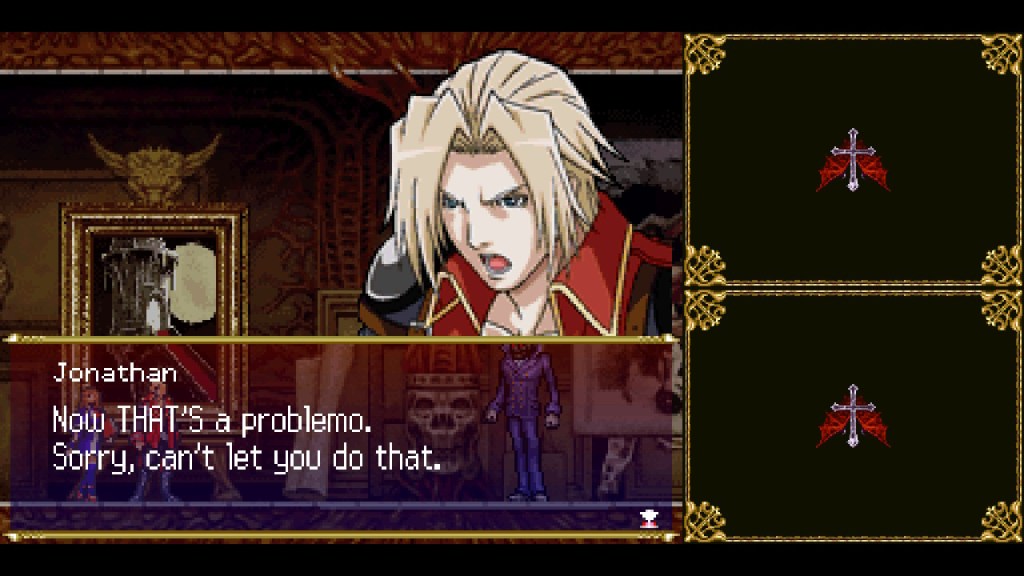

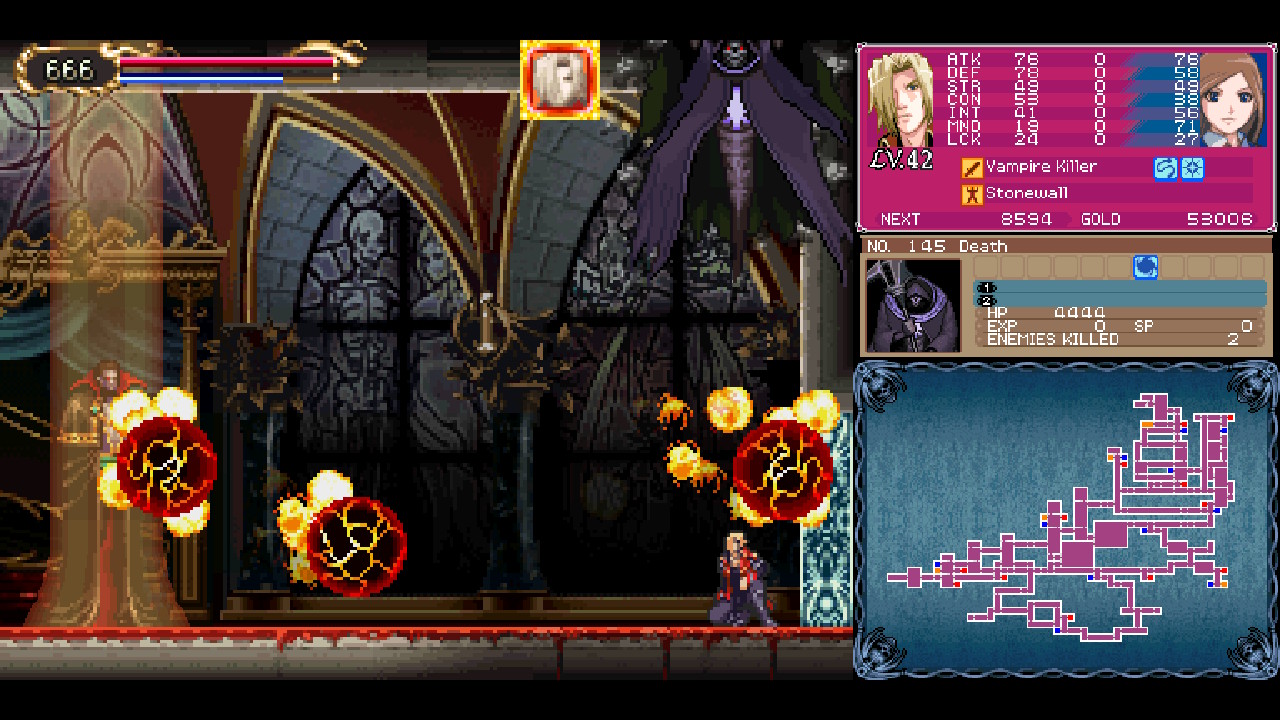
Jonathan’s growth as a character and his eventual mastery of the Vampire Killer really works on multiple levels, and in my opinion it really elevates the game’s story by combining a satisfying narrative build up with a satisfying gameplay build up. The Vampire Killer sequence being optional and almost certainly requiring the player returning later really sticks with you as something you feel compelled to get done, and it’s gratifying to land its Holy element attacks against the vampires (and worse?) that you’ll face through the game’s great finale. Speaking of which, man, what a last boss. Jonathan and Charlotte squaring up against a tag-team of Death and Dracula is just awesome. Both bosses come with the standard kit they have in other Castlevanias, but the difficulty is elevated dramatically by having to deal with both at once. With some new tricks in tow, you’ll find that they put up a surprisingly challenging fight, and it’s super rewarding to overcome.
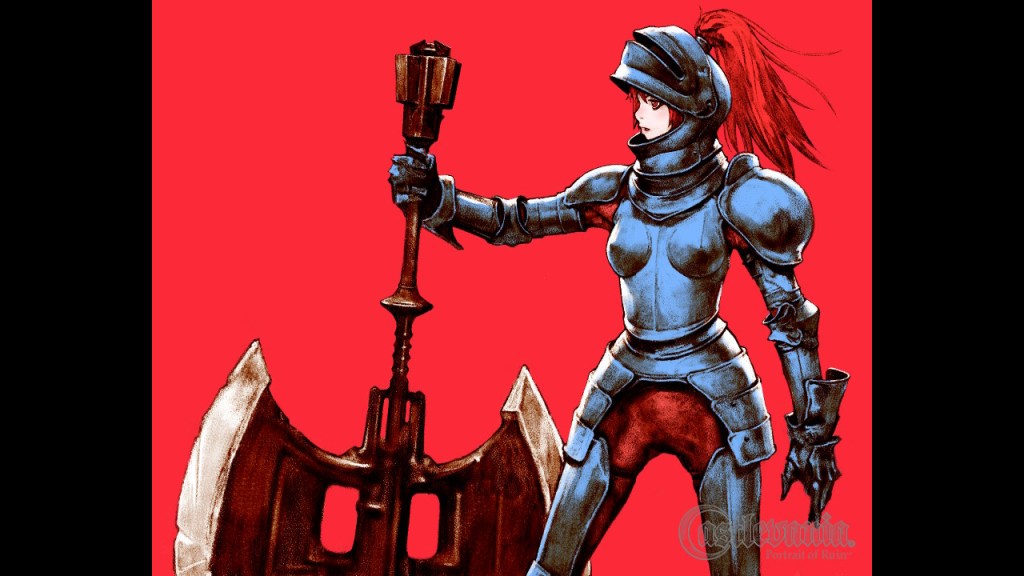
Probably my only big complaint is the late game reuse of the four main portrait areas, which do a good job to extend the game, but certainly aren’t as special as the first time you visit these zones. Nonetheless, there’s absolutely tons to see and do, with Portrait almost certainly being the biggest Castlevania game ever made. It even features three unlockable character modes to replay the game with. Sadly, I feel I must mention that one of these unlockable character sets feels like it has extremely compromised playability in this new port. The “Sisters” mode has you take control of vampire antagonists Stella and Loretta, who sport a genuinely fun and creative control scheme that revolves almost completely around the DS touch screen. Sadly, playability is obviously dramatically reduced in this new release, with the on-screen cursor controls being entirely too slow for the task. To be honest, I found it quite unwieldy on Switch as well, having to hold a Switch in one hand pretty much requires me to have some form of rest for the other half of the machine, lest I damage my wrists worse than they already are. It might be okay on the PC version if mouse support is a thing, but having not played that version I promise nothing. It’s an unfortunate miss for the game, but rest assured that there’s still so, so much to enjoy.
All in all, Portrait fucks. The two-character gameplay is very different from all other Castlevania titles, the protagonists are a strong narrative duo who bring their own story quirks to the table and really stand apart from the standard Belmont stories, while also having growth very different from Soma’s big twist.
tl;dr: With smart character-switching gameplay, a unique sense of humor, and a surprisingly heartwarming story, Portrait of Ruin adds a lot to the Igavania template that can sometimes feel quite predictable.

This article is the third of a four-part series on Castlevania Dominus Collection.
Click here to jump to Part I – Castlevania Dominus Collection.
Click here to jump to Part II – Castlevania: Dawn of Sorrow.
Click here to jump to Part IV – Castlevania: Order of Ecclesia.
 「RISINGSUPERBLOG」
Leave a comment