Publisher: Konami
Developer: Konami
Release Date: August 27, 2024 (original release October 21, 2008)
Version Played: Nintendo Switch

This article is the fourth of a four-part series on Castlevania Dominus Collection.
Click here to jump to Part I – Castlevania Dominus Collection.
Click here to jump to Part II – Castlevania: Dawn of Sorrow.
Click here to jump to Part III – Castlevania: Portrait of Ruin.
This article contains full spoilers for Castlevania: Order of Ecclesia.
Of the three DS Castlevania titles, Order of Ecclesia is the one I remembered the most fondly. The punishingly high difficulty and perceived artistic return to form stand out as key elements of Ecclesia in my mind, with Masaki Hirooka brought in to help deliver on another fully serious and “mature” looking Castlevania (his personal website is actually still online, by the way! Last updated in 2009, it’s a real blast from the past!) Ecclesia was an impactful new entry, with a tragic protagonist, strong mechanical concepts and some very different level design ideas. That said… as an adult… I don’t feel like this stuff all lands. I came away from Order with the biggest change in opinion, and definitely the worst one. It bears pointing out that I did just play Dawn of Sorrow and Portrait of Ruin back to back with this, so I will acknowledge that a certain amount of fatigue could have been setting in as well, but I do think it has issues beyond that.

First off, let’s talk about Shanoa and her place in the world of Igarashi game design. Soma Cruz and his Tactical Soul system remains a watershed moment, with each enemy in the game granting the player (mostly) unique abilities and encouraging interaction with new foes as they encounter them. Jonathan and Charlotte regress somewhat in terms of pure brilliance, but their differences, instant swapability, and cooperative potential elevate them a lot even if their unique systems aren’t always the sharpest on their own.
Shanoa’s Glyph System struggles to reach any of these, sadly. Similar to Aria’s Tactical Soul system, Shanoa has three Glyph slots- left arm, right arm, and back, which map to X, Y, and R. Arm glyphs are your standard weapons, and the back glyph is an extra ability. Do you want mobility? Maybe a buff? It’s your choice! Glyphs are acquired exactly as Souls in Aria and Dawn, largely from enemies, with a few specific ones found waiting for you in levels. Unlike those games, not all enemies have Glyphs, far from it. Less than half of the enemies in the game offer Glyphs, and the raw number of Glyphs is lower than Aria or Dawn’s Soul count, and still less even Portrait’s abilities. Many Glyphs repeat with more powered up versions as well, making for a list that I imagine is somewhere around forty-fifty unique abilities/weapons, tops. While this sounds like it’s still a decent amount, Glyphs also replace weapons entirely, whereas previous titles had weapons in addition to that game’s unique ability system. I remember this low quantity being a bummer as a kid, and I’m even more down on it now.

There are thankfully three small differentiating elements to Shanoa’s powers. Firstly, she gets access to so-called “Glyph Sleeves” very early on. These allows you to equip up to three sets of Glyphs and rotate through them with a quick button press. It’s not as interesting as Charlotte and Jonathan’s tag-teaming, but it took Soma far too long to get access to this sort of ability so it does remain a positive here.
Secondly, the method in which you obtain Glyphs has a fun wrinkle. Soma obtains souls passively- once an enemy has dropped theirs, the soul will shoot off towards you and you’ll automatically collect it as long as you haven’t left the screen. In Order, the player has to hold up on the D-Pad for Shanoa to actively start absorbing a Glyph. This takes about three seconds, so it’s not as instant and definitely can break up the pace a bit at times. On the flip side, the game does play with the concept creatively at times. Many enemies cast spells by manifesting their Glyph, and if you absorb their Glyph out of the air before they can cast their spell, you’ll block their ability and steal it for yourself. Some of the toughest bosses take great advantage of this idea to let you block and steal their most powerful tools if you react properly, which is legitimately really cool. A few environmental puzzles also require you to work out a way to absorb the Glyph, including one clever one with a strong river pushing Shanoa out of absorption range from the Glyph as she tries to take it.

The last saving grace to Shanoa’s gameplay identity is a bit of a double edged sword- you have to use MP to use your Glyphs. I know that sounds like all abilities in previous Castlevania titles, but in this case it bears repeating that Shanoa’s base weapons are Glyphs! Even performing normal attacks saps your resources. This is probably Shanoa’s strongest differentiating feature, and while I think it’s sufficiently different, I wouldn’t say that it makes her feel better to play as. With pretty standard gear, it’s largely a non-issue, but also not really a benefit, either. Stronger gear will require you to be careful with your attacks, in a way that’s very similar to how you pace out your stamina meter in Souls titles. Given how Shanoa frequently runs out of MP performing standard actions, she can come off as feeling somewhat less capable mechanically. Other than MP, Shanoa has a second stock of spendable resources in the Castlevania standard currency- Hearts. Not to be confused with her HP. Hearts have long been used in Castlevania titles to wield your sub-weapons, and yes, it’s always been a bit odd aesthetically.
Shanoa spends Hearts to use stronger abilities, and Hearts are restored much more sparingly than your regenerating MP meter. I often found myself short on Hearts, which I feel indicates just how effective and reliable Heart-consuming abilities are, but Hearts are unfortunately not plentiful at all. You’ll find one or two here and there as you defeat enemies and break objects and you restore ten by absorbing a Glyph. The Castlevania mainstay enemy, White Dragon, still drops a beautiful stream of them, and rare/expensive items will restore a few. The only way to significantly restore them for free is to return to the Village. I often found that Order’s MP and Heart systems in unison created a slightly undesirable friction that previous Igarashi Castlevanias weren’t in need of, and I wish they were a bit more forgiving with either Heart costs or availability.
Shanoa thus demands more patience and caution than previous Castlevania protagonists. Her high ability cost contributes greatly to the high difficulty Order is known for. Even besides Shanoa’s limitations, enemies hit particularly hard and save point placement can be tricky. It’s a unique Castlevania experience, but not necessarily a better one. I don’t think this is really a problem per se, but when adding it to my biggest complaint- level design- I think it doesn’t work out well.
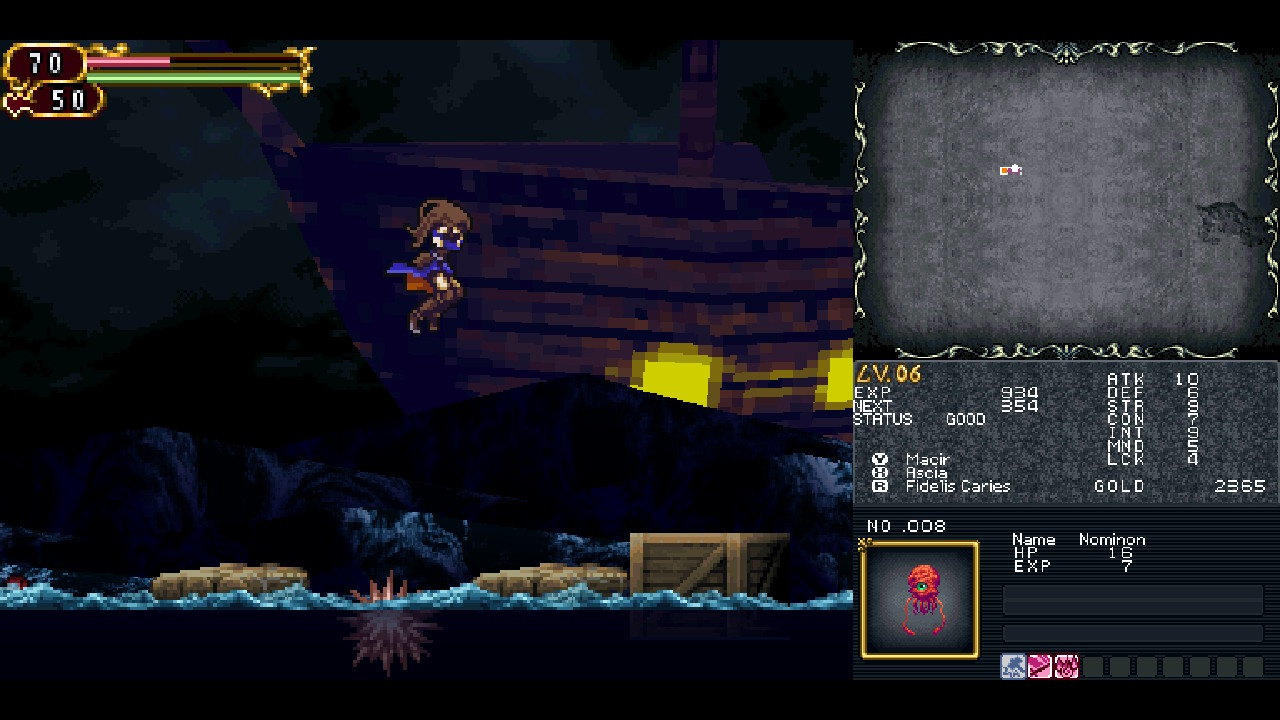
Order of Ecclesia’s level design… boy, it just doesn’t feel good to me on the whole. The game’s structure is different to other Igarashi titles, which I think is really cool, actually! You have a collection of levels attached to a world map menu, by which you access them all. Though you have to travel through an area to unlock subsequent ones, once they’re unlocked you can just skip around via the world map. Dracula’s Castle doesn’t even figure into the game until the very end, at which point it reveals itself in one of the game’s few legitimately awesome moments.

Aside from one small town that you arrive at early in the game (which you’ll be returning to very often), most levels don’t offer a lot to return to. Worse yet, quite a few of the levels are painfully, painfully linear. While linear collections of hallways forming de-facto levels are common across Igarashi’s Castlevania titles, I think the overall castle setting helps to mask it by featuring hidden paths to other areas alongside other level design tricks. Order’s levels concluding by dumping the player in a world map menu really lays bare how linear they are, and I really think they hurt the game. No, really, have a look at these maps. Two of them are literally flat lines, and many more are flat lines twisted into a less flat shape. Dracula’s Castle is thankfully still pretty solid, though I do feel it’s not up to par with other Igarashi titles’ castles as it lacks in density and contains many lengthy linear stretches alongside a lack of warp rooms.
One specific complaint I have concerning the levels is the arrangement of two completely underwater levels really near one another in the story (Somnus Reef and Kalidus Channel), one of which features a variety of strong, poison inflicting enemies. That combination is tough to deal with, and I became well and truly fed up with water levels as I played through the game, as I never fully felt super well equipped to deal with them. Maybe that just came down to the quirks of my playthrough, but if you hate water levels, then, you know, caveat emptor and all that.
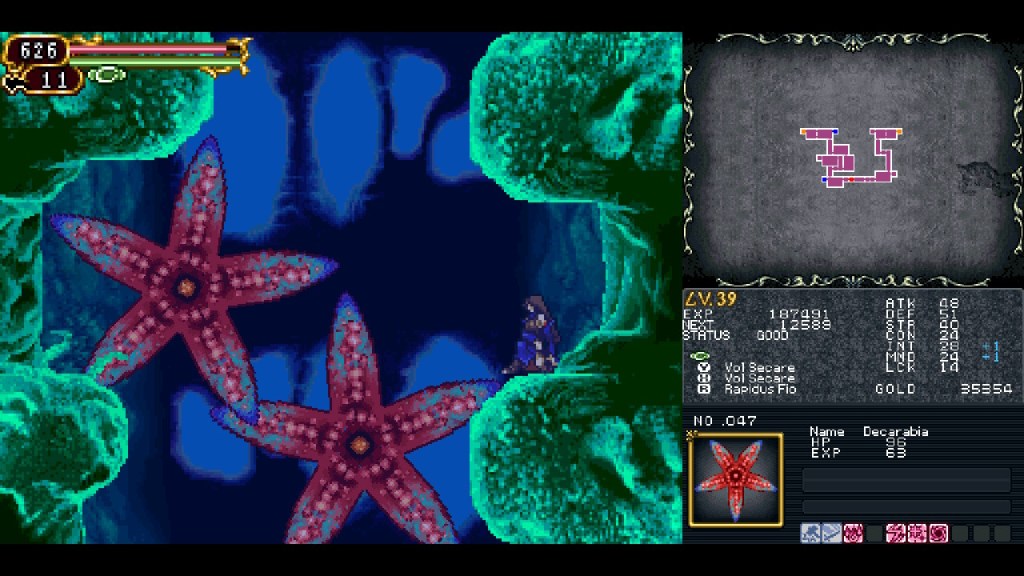
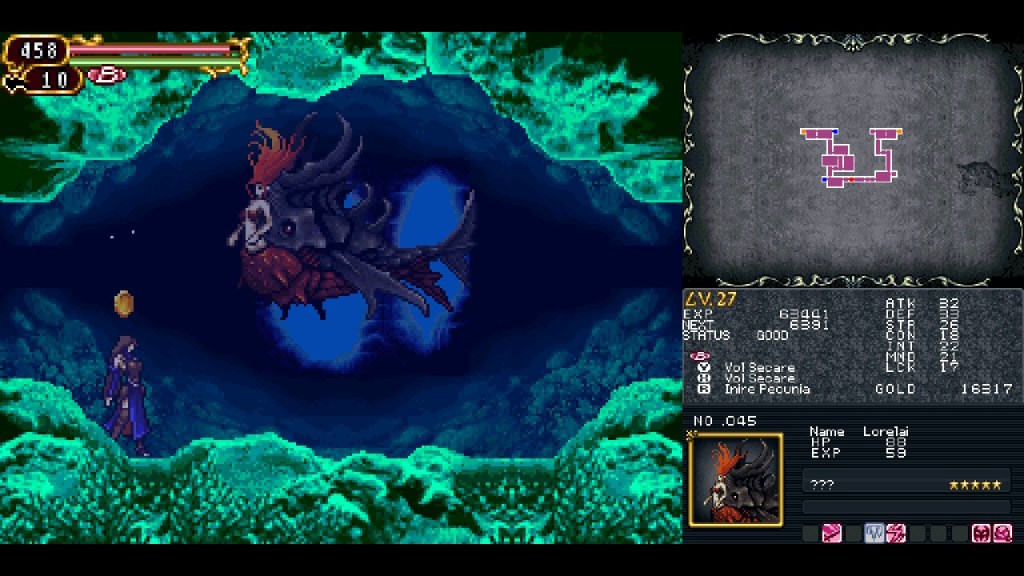
Another level design quirk that caused me some trouble early on was forgetting how important it is to visit the village between stages. Early on, I would brazenly charge from stage to stage in the spirit of pretty much every Castlevania game, only to find that the next save point would often end up being a risky distance in (with some maps having no save points at all- refer back to this set of maps and look for the red coloured save rooms). This is definitely a result of having just played two of these games and running headfirst into a totally different style of map design, so I don’t totally blame the game for this. You’re really supposed to go back to the town fairly often, so do make sure you do that. Death has always been brutal in these titles, and with Ecclesia’s somewhat elevated difficulty, it comes especially fast in this game.
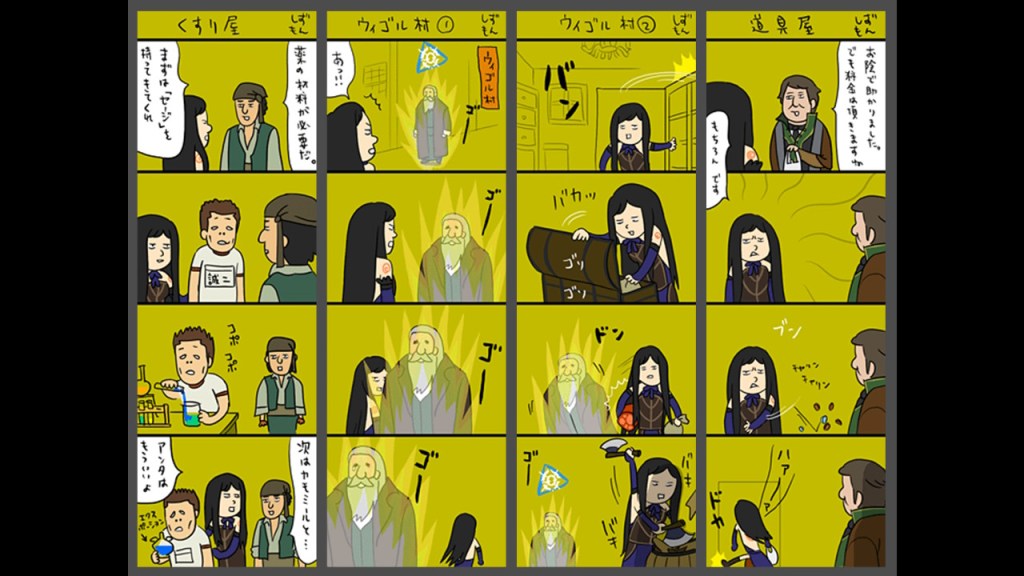
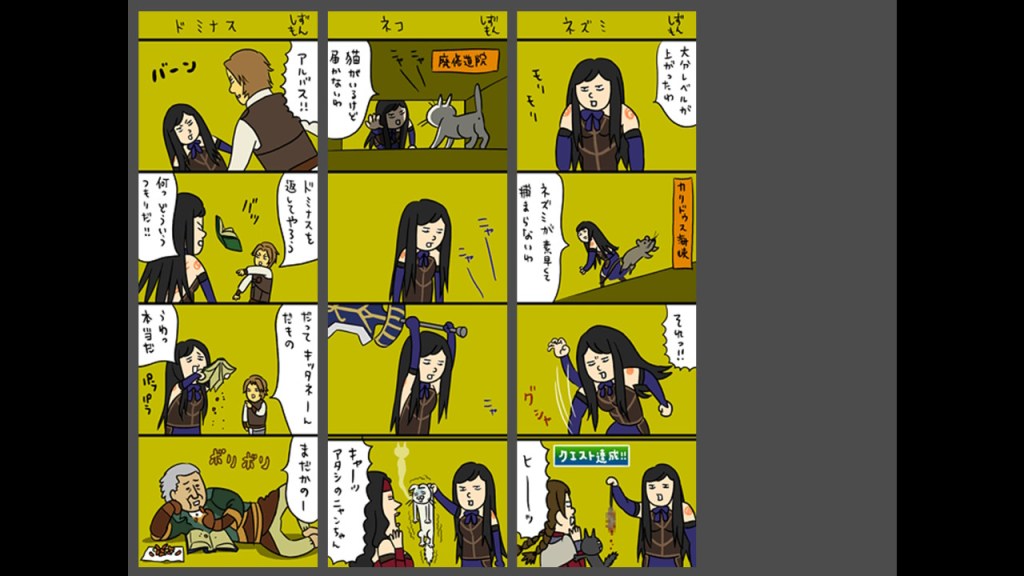
Speaking of level design, let’s get to Wygol Village. Like I mentioned before, this is a safe area that acts as something of a hub, including a save point and the only way to restore your hearts for free across the whole game. As you explore the various levels, you’ll rescue villagers who’ve been kidnapped by the antagonist, Albus. These villagers will run straight back to town, where they’ll usually offer Shanoa simple side quests. Collect a few of x item, kill a couple y enemies, et cetera. The more creative ones require you to take pictures of rare creatures or have Shanoa illustrate places that an old woman no longer has the strength to visit herself, and they’re solid and worthwhile additions. Otherwise the side quests are quite plain, and the rewards are of decidedly mixed quality. While you’ll be able to pick up some great hats (one can reveal hidden chests, for example) and some much-needed Gold, you’ll just as often get given completely obsolete armor and accessories.
The Castlevania titles have long featured single use food items. From fully plated meat hidden in walls in the retro titles, to whole buffets worth of unique food items in the Igarashi games. These items have always been odd, in that while it’s satisfying to randomly find a cantaloupe in Dracula’s Castle, you have no idea how effective it is, and in practice you’ll often find that the unique food items have historically often not been that good compared to more standard healing items like potions. Ecclesia continues this longstanding design tradition, and continues to fail to improve it despite featuring a chef in the Village who will prepare food if you bring the right ingredients. Igarashi’s later title, Bloodstained: Ritual of the Night, would actually integrate a genius improvement to food items by offering a unique permanent stat buff each time you consumed a food item you’d never eaten before- a really genius trick that elevates all food items the first time you find them, tempting you into consuming them for the permanent boost even if you really ought to be saving their HP recovery for a tricky spot. This concept would have been very much at home with Order’s chef character, but alas, I guess that idea just wasn’t ready yet. I’m humbly requesting that some industrious modder out there overhaul Ecclesia’s chef character and food items, but until that happens, the chef can at least make you a corn soup. That’s about as good as it gets.
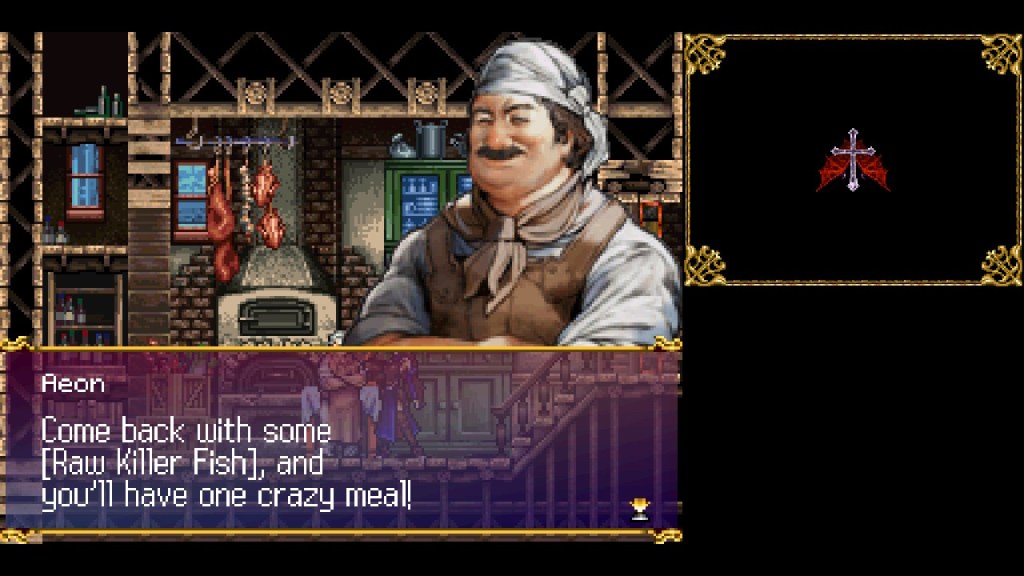
Secretly though, Order’s buyable food items are actually across the board sliiiightly better value for money than potions, but unless you experiment yourself, you’d never know it. The various bottled tonics are extremely clear about their effectiveness, proudly displaying the amount they heal for, whereas food items still only have flavour text, requiring you to math it out yourself. I do think this is a bit of a flaw, as the way the costs and healing effects are presented really give the impression that Potions are the most efficient way to heal themselves despite all their work on the chef’s sidequests. I really suspect a lot of people finished the game without this ever clicking. Two whole paragraphs on food? Boy, I really had to pick this nit, huh?
To circle back to the villagers, you’ll find at some point in the game that saving the villagers is actually not just a fun optional side activity at all. The game’s real ending actually necessitates that you’ve saved them all! The game helpfully (and briefly) offers some visual clues as to where the remaining ones are after the bad ending plays out, so make sure you’re paying attention!
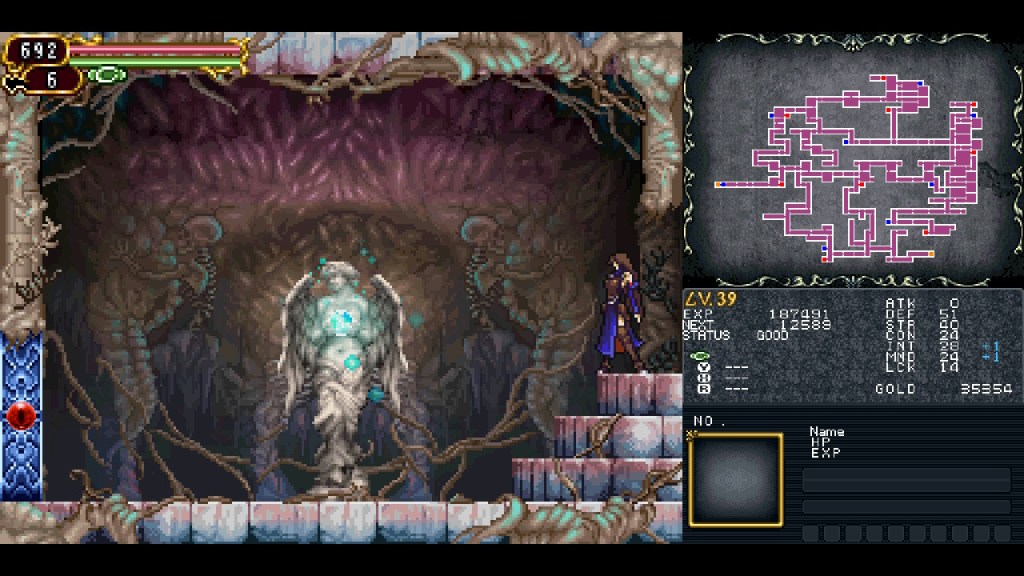
I’ve been putting off talking about the story up until now, but there’s no getting around it. I don’t really like Order of Ecclesia’s story.
The game opens with a very stiff cutscene that tries to do way too much at once. Shanoa is presented as an extremely stoic member of Ecclesia, an organization meant to tackle Dracula once and for all. We open on her cult-mate, Albus, trying and failing to give Shanoa a fright. The writing is awkward and too full of exposition to come off very naturally at all for my tastes. Albus’ failed prank segues quickly into anger when he learns that Shanoa will be bestowed with the organization’s most powerful Dominus Glyphs. He immediately betrays Ecclesia by stealing the Glyphs, and goes off on a kidnapping spree, snatching away all the villagers from their home. The leader of Ecclesia, Barlowe, commands Shanoa to collect the Dominus Glyphs, and she complies.
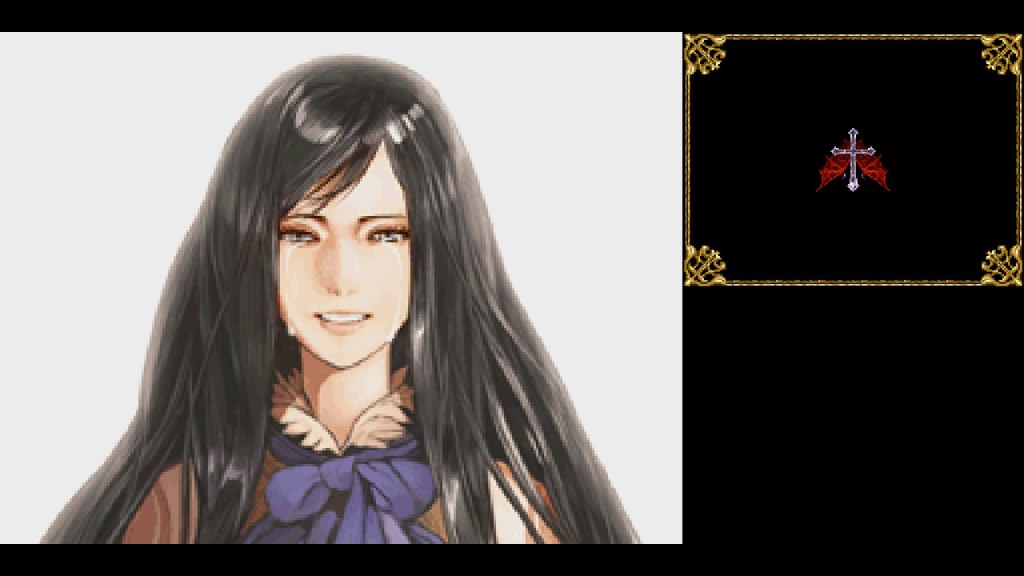
It’s a reasonable opening to the story, but told in what I think is poor fashion. It’s too much all at once, and there’s a lack of clarity on many elements. Shanoa’s emotions are stolen in the process, but she behaved no differently before they were taken, which feels odd. Flashbacks to happier days could have perhaps remedied this, but without that sort of thing we’re left with what is largely an overly stoic and uninteresting character. Her interactions with the villagers offer occasional cute moments that stick with you, but as far as the main story goes, you’ll find yourself retreading the same chase for Albus over and over again.
Eventually, you discover that Albus was just trying to save you all along. Dominus’ power will require the sacrifice of a soul to fully activate, and Barlowe had intended to sacrifice Shanoa without her knowing it (indeed, the bad ending has this scenario play out in front of you). In an extremely contrived and only slightly cool moment, we learn that the villagers are all distant descendants of the Belmont clan, and Albus had kidnapped them to research their blood so he could use Dominus without it taking control of him. Right, Dominus also turns out to be Dracula’s powers, by the way. That’s why he needs the Belmont blood.
But like… it’s all very contrived, to me. Okay, so you want to prevent Barlowe from sacrificing Shanoa so badly that you’d steal everything and kidnap twelve innocent villagers. I mean, can’t you start by explaining what’s really happening to Shanoa? I know the plot specifies that Albus had spoken to Barlowe and he had lied to Albus about giving him Dominus, but just like… tell Shanoa. If you and Shanoa are really as close as the narrative repeatedly affirms you’re supposed to be, shouldn’t Shanoa be able to trust that? Revisiting the opening narrative beats only makes this stick out to me more.
Furthermore, Albus, do you really need to kidnap all the villagers? You can’t just take their blood and return them? Do you really need to spread them around the game’s world? The narrative design feels fumbled in how arbitrary some elements are, and the series of big last act twists just didn’t land for me on replay. Albus being this secret saviour who has to do all this privately in secret is very predictable and feels to me like it undermines Shanoa’s agency in the story, and it feels like Albus’ need to protect her is more important to him than his ability to trust that Shanoa could believe in him. The story ultimately does not address this in a satisfactory way, and concludes with Albus sacrificing his soul in place of Shanoa’s as the final saviour once she’s tackled Dracula. It’s a big emotional moment, but given that the player lacks any context on Albus and Shanoa’s supposedly good past relationship, I found it quite trite. A fair positive I will offer the game is that once you deal with Albus and Barlowe around the 70% mark, Shanoa’s self-motivated attack on Dracula’s Castle is rad, and it’s nice that she gets some measure of agency in her own story. It’s a low bar.
While writing this article on Order of Ecclesia, I’ve routinely been thinking back to the time I streamed my way through it back in 2017. Did I feel differently at the end? Am I now going to be embarrassed to find that the very words I’m writing now run pretty much opposite to an opinion from my early twenties? I finally decided to check, and to my surprise, no, they don’t. Turns out that last time I played Ecclesia, I also felt it was the weakest DS title. I also had the same level design complaints. I had the same gear complaints. I had the same complaints about Hearts. I even had complaints about some abilities that really ought to be fully passive, which is making me kick myself for not catching it this time through! So yeah, at the end of the day, I’m very confident in my assessment on Order. Definitely not a bad game by any means, but this game coming after Aria, Dawn, and Portrait is not flattering to it. It’s a big step down in so, so many little ways, and Shanoa feels somewhat wasted in the story. I’m sad to come to this conclusion again, but I guess that’s just how it is. Hopefully I’ll remember these feelings a decade from now so I won’t have to do this all over again.
tl;dr: The finale of Igarashi’s DS trilogy offers a creative take on the series that unfortunately misses more times than it lands when it comes to its wide array of fresh ideas.


This article is the first of a four-part series on Castlevania Dominus Collection.
Click here to jump to Part I – Castlevania Dominus Collection.
Click here to jump to Part II – Castlevania: Dawn of Sorrow.
Click here to jump to Part III – Castlevania: Portrait of Ruin.
 「RISINGSUPERBLOG」
Leave a comment